
Free tool & printable · No sign-up
Pet care reminder planner
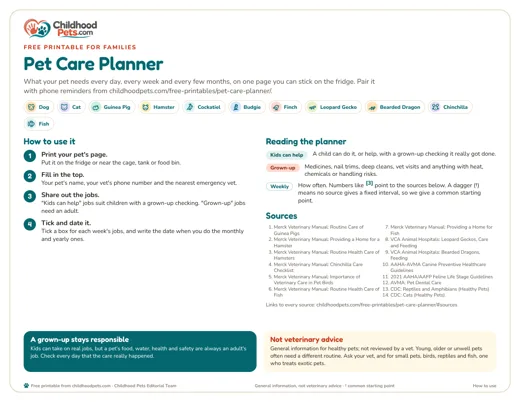
Pick your pets and get a simple care schedule: what to do every day, every week and every month. Add it to your phone calendar as repeating reminders, or print it for the fridge.
Build your family's reminders
Choose your pets, set times that fit your day, then download one calendar file with every reminder. Your choices stay on this device.
How to add the reminders to your phone
iPhone or iPad
Tap "Add to my calendar", then open the downloaded file (Safari shows it in Downloads). Tap Add All and pick a calendar. A separate "Pet care" calendar makes the reminders easy to hide or remove later.
Google Calendar (Android)
On a computer, open Google Calendar, then Settings → Import & export → Import and choose the file. The reminders then show on every phone signed in to that account. Some Android phones also open the file directly.
Outlook
Open the file, or in Outlook on the web go to Calendar → Add calendar → Upload from file.
Each reminder repeats on its own schedule and lists the jobs, who usually does them, and a link back here. To change times later, delete the "Pet care" events and import a new file.
Pet care schedules, pet by pet
These are the routines inside the planner. "Kids can help" jobs are fine for children with a grown-up checking; "Grown-up" jobs need an adult. Frequencies come from veterinary and public-health sources where they give one (numbered links). Where they don't, we give a common starting point, marked with a dagger (†); your vet can tailor it.
Dog care scheduleMeals, walks, tooth brushing, grooming, parasite prevention and the yearly checkup.
Every day
- Fresh water† Daily Kids can help Wash the bowl and refill with cool, fresh water
- Meals† Twice daily Kids can help Most adult dogs eat twice a day. A grown-up measures the amount your vet suggests
- Walks, play and potty breaks† Daily Kids can help Several outings a day. A grown-up holds the leash until child and dog are ready
- Brush teeth† Daily Grown-up Dog toothpaste only. Ask your vet first if the mouth seems sore
Each week
- Brush the coat† Weekly Kids can help More often for long or double coats
- Ear, paw and skin check† Weekly Kids can help Look for redness, cuts, lumps or ticks
Every few weeks
- Wash the bed and toys† Every 2 weeks Grown-up Hot wash, dry fully
- Nail trim† Monthly Grown-up When nails click on the floor. A groomer or vet can help
- Flea, tick and heartworm prevention[10] Monthly Grown-up Exactly as your vet prescribes; many products are monthly
- Teach kids to leave a dog alone while it eats, sleeps or chews.
- Puppies need more meals and more potty breaks than this schedule shows. Follow your vet's puppy plan.
The ready-made calendar file uses our default times (7:30 am, 6 pm, Saturdays at 10 am). Use the planner above to pick your own. More in our dog guides.
Cat care scheduleLitter scooping, meals, play, grooming, claw care and checkups.
Every day
- Fresh water† Daily Kids can help Rinse and refill the bowl or fountain
- Meals† Twice daily Kids can help Measured meals, often split into two or more a day
- Scoop the litter box[14] Daily Kids can help Daily scooping also lowers toxoplasmosis risk. Wash hands after
- Play time† Daily Kids can help Wand toys or chase games; put strings away after
- Brush teeth† Daily Grown-up Cat toothpaste only, if your cat accepts it. Ask your vet how to start
Each week
- Brush the coat† Weekly Kids can help Long-haired cats need it more often
Every few weeks
- Empty, wash and refill the litter box† Every 2 weeks Grown-up With clumping litter; more often for other litters
- Claw trim† Every 2 weeks Grown-up Front claws usually grow fastest
- Parasite prevention[11] Monthly Grown-up As your vet prescribes; guidelines favor year-round protection
- Anyone who is pregnant should not scoop litter (CDC).
- A cat that hides, stops eating or strains in the litter box needs a vet the same day.
The ready-made calendar file uses our default times (7:30 am, 6 pm, Saturdays at 10 am). Use the planner above to pick your own. More in our cat guides.
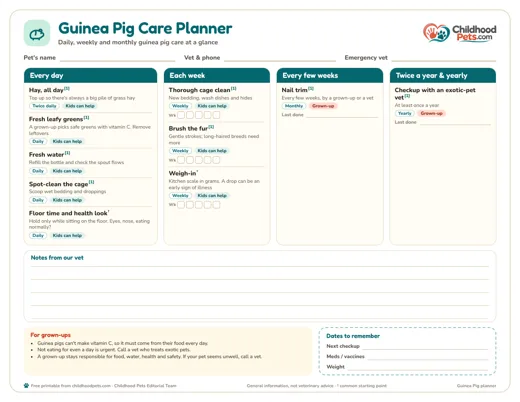
Guinea Pig care scheduleUnlimited hay, daily greens, spot cleans, a weekly deep clean and nail trims.
Every day
- Hay, all day[1] Twice daily Kids can help Top up so there's always a big pile of grass hay
- Fresh leafy greens[1] Daily Kids can help A grown-up picks safe greens with vitamin C. Remove leftovers
- Fresh water[1] Daily Kids can help Refill the bottle and check the spout flows
- Spot-clean the cage[1] Daily Kids can help Scoop wet bedding and droppings
- Floor time and health look† Daily Kids can help Hold only while sitting on the floor. Eyes, nose, eating normally?
Each week
Every few weeks
- Nail trim[1] Monthly Grown-up Every few weeks, by a grown-up or a vet
Twice a year & yearly
- Checkup with an exotic-pet vet[1] Yearly Grown-up At least once a year
- Guinea pigs can't make vitamin C, so it must come from their food every day.
- Not eating for even a day is urgent. Call a vet who treats exotic pets.
The ready-made calendar file uses our default times (7:30 am, 6 pm, Saturdays at 10 am). Use the planner above to pick your own. More in our guinea pig guides.
Hamster care scheduleEvening feeding and water, spot cleans, gentle part-cleans and a health check.
Every day
Each week
- Spot-clean the pee corner† Every 2 days Kids can help Scoop it out and add a little fresh bedding
- Health check†[3] Weekly Kids can help Eyes, teeth, wet bottom, eating normally? Tell a grown-up
Every few weeks
- Part cage clean† Every 2 weeks Grown-up Swap some bedding and wash dishes. Keep some old bedding so it smells like home
Twice a year & yearly
- Vet checkup†[3] Yearly Grown-up Soon after you get your hamster, then as your exotic-pet vet advises
- Hamsters sleep in the day. Waking one is a common cause of bites, so plan care for the evening.
- A wet bottom or diarrhea needs a vet who treats exotic pets the same day.
The ready-made calendar file uses our default times (7:30 am, 6 pm, Saturdays at 10 am). Use the planner above to pick your own. More in our hamster guides.
Cockatiel care scheduleFresh food and water, cage paper, out-of-cage time, weekly scrubs and a yearly avian vet visit.
Every day
- Fresh water and food† Daily Kids can help Clean dishes, fresh water, refill pellets or seed
- Fresh veggies† Daily Kids can help Remove leftovers after a few hours
- Change the cage paper† Daily Kids can help Check droppings look normal while you do it
- Out-of-cage time† Daily Grown-up Windows shut, ceiling fan off, other pets out of the room
Each week
- Scrub perches, dishes and toys† Weekly Grown-up Hot water, rinse well, dry before putting back
- Rotate a toy† Weekly Kids can help Keeps the cage interesting
Every few weeks
- Deep clean the cage† Monthly Grown-up Bird-safe cleaner only, with the bird in another room
Twice a year & yearly
- Avian vet checkup[5] Yearly Grown-up Every year, including nails and beak
- Fumes from overheated nonstick (PTFE) pans, aerosols and scented candles can kill birds.
- Birds hide illness. A fluffed-up, quiet bird needs an avian vet soon.
The ready-made calendar file uses our default times (7:30 am, 6 pm, Saturdays at 10 am). Use the planner above to pick your own. More in our cockatiel guides.
Budgie care scheduleThe same daily routine as a cockatiel, sized for a smaller bird.
Every day
- Fresh water and food† Daily Kids can help Clean dishes, fresh water, blow away empty seed husks
- Fresh veggies† Daily Kids can help Remove leftovers after a few hours
- Change the cage paper† Daily Kids can help Check droppings look normal
- Out-of-cage or chat time† Daily Grown-up Room check first: windows, fans, other pets
Each week
- Scrub perches, dishes and toys† Weekly Grown-up Hot water, rinse well
- Rotate a toy† Weekly Kids can help Budgies get bored quickly
Every few weeks
- Deep clean the cage† Monthly Grown-up Bird-safe cleaner, bird in another room
Twice a year & yearly
- Avian vet checkup[5] Yearly Grown-up Every year
- Keep nonstick-pan fumes, aerosols and candles away from the bird's air.
- Budgies are social; a pair or lots of daily attention keeps them happy.
The ready-made calendar file uses our default times (7:30 am, 6 pm, Saturdays at 10 am). Use the planner above to pick your own. More in our budgie guides.
Finch care scheduleHands-off birds: daily food, water and a bath dish, weekly cleaning and a yearly check.
Every day
- Fresh water and seed† Daily Kids can help Blow away husks; finches can starve with a bowl full of empty shells
- Bath dish† Daily Kids can help Shallow dish of fresh water; remove it after bath time
- Change the cage paper† Daily Kids can help Check droppings look normal
- Watch time† Daily Kids can help Finches prefer watching to handling. Check everyone is active and eating
Each week
- Scrub perches and dishes† Weekly Grown-up Hot water, rinse and dry
Every few weeks
- Deep clean the cage† Monthly Grown-up Bird-safe cleaner
Twice a year & yearly
- Avian vet checkup[5] Yearly Grown-up Every year
- Finches live in pairs or groups; watch for bullying at the food dish.
- A bird that sits fluffed up on the cage floor needs an avian vet soon.
The ready-made calendar file uses our default times (7:30 am, 6 pm, Saturdays at 10 am). Use the planner above to pick your own. More in our finch guides.
Leopard Gecko care scheduleTemperature checks, fresh water, spot cleans and 2 to 3 feeds a week for adults.
Every day
Each week
- Feeding (adults)[8] 2–3× a week Grown-up Adults 2 to 3 times a week; juveniles every 1 to 2 days. Dust insects as your vet advises
- Mist the humid hide† Every 2 days Kids can help Keep the moss damp, not soaking
- Shed and weight check† Weekly Kids can help Stuck skin on toes or tail? Tail getting thinner?
Every few weeks
- Deep clean the enclosure†[13] Monthly Grown-up Replace or wash substrate and decor. Clean away from the kitchen
Twice a year & yearly
- Reptile vet checkup†[13] Yearly Grown-up Regular checkups with an exotic-pet vet
- CDC: children under 5 shouldn't touch reptiles, and everyone washes hands after touching a gecko or its tank.
- Never wash tank gear in the kitchen sink.
The ready-made calendar file uses our default times (7:30 am, 6 pm, Saturdays at 10 am). Use the planner above to pick your own. More in our leopard gecko guides.
Bearded Dragon care scheduleDaily greens and water, insects every 1 to 3 days for adults, calcium, soaks and UVB bulb changes.
Every day
Each week
Every few weeks
- Deep clean the enclosure†[13] Monthly Grown-up Away from the kitchen
Twice a year & yearly
- Replace the UVB bulb† Every 6 months Grown-up UVB fades before the light looks dim. Follow the bulb maker's timing
- Reptile vet checkup†[13] Yearly Grown-up Regular checkups with an exotic-pet vet
- CDC: children under 5 shouldn't touch reptiles; bearded dragons have been linked to Salmonella outbreaks.
- Waxworms and superworms are occasional treats, not daily food.
The ready-made calendar file uses our default times (7:30 am, 6 pm, Saturdays at 10 am). Use the planner above to pick your own. More in our bearded dragon guides.
Chinchilla care scheduleDaily hay, dust bath and exercise, bowls every other day and a weekly full clean.
Every day
- Fresh water, food and hay[4] Daily Kids can help Pellets, unlimited hay, about 1 teaspoon of veggies
- Dust bath[4] Daily Kids can help About 10 minutes, then take the bath out
- Supervised exercise[4] Daily Grown-up About 2 hours in a chin-proofed room
- Change the bedding[4] Daily Kids can help Fresh bedding where it's soiled
- Check the room temperature† Daily Kids can help Chinchillas overheat easily; keep the room cool
Each week
Twice a year & yearly
- Checkup with an exotic-pet vet† Yearly Grown-up Yearly, including teeth
- Never bathe a chinchilla in water; use dust only.
- Drooling, not eating or small droppings need an exotic-pet vet quickly.
The ready-made calendar file uses our default times (7:30 am, 6 pm, Saturdays at 10 am). Use the planner above to pick your own. More in our chinchilla guides.
Fish care scheduleDaily checks and feeding, water tests and partial water changes every 2 weeks, filter care monthly.
Every day
Each week
- Top up and wipe algae[6] Weekly Grown-up Add treated water for evaporation, clean the glass and lid
Every few weeks
Twice a year & yearly
- Check the lights and equipment[6] Every 6 months Grown-up Replace UV tubes; service pumps
- Unplug heaters and filters before hands go in the tank. Wash hands after.
- Find a vet who treats fish before you need one.
The ready-made calendar file uses our default times (7:30 am, 6 pm, Saturdays at 10 am). Use the planner above to pick your own. More in our fish guides.
A grown-up stays responsible
Reminders help a busy family remember, and kids can take on real jobs. But a pet's food, water, health and safety are always an adult's job. Check every day that the care really happened.
Not veterinary advice
This planner is general information for healthy pets, not veterinary advice, and it hasn't been reviewed by a vet. Puppies, kittens, young reptiles, seniors and pets with health conditions often need a different schedule. Ask your vet what's right for your pet, and for small pets, birds, reptiles and fish, find one who treats exotic pets. If your pet seems unwell, call a vet.
Make it a family routine
Pair the planner with our free pet chore chart, so kids can tick off their jobs. Still choosing? Try the pet finder and the pet cost calculator.
Sources
- Merck Veterinary Manual: Routine Care of Guinea Pigs
- Merck Veterinary Manual: Providing a Home for a Hamster
- Merck Veterinary Manual: Routine Health Care of Hamsters
- Merck Veterinary Manual: Chinchilla Care Checklist
- Merck Veterinary Manual: Importance of Veterinary Care in Pet Birds
- Merck Veterinary Manual: Routine Health Care of Fish
- Merck Veterinary Manual: Providing a Home for Fish
- VCA Animal Hospitals: Leopard Geckos, Care and Feeding
- VCA Animal Hospitals: Bearded Dragons, Feeding
- AAHA-AVMA Canine Preventive Healthcare Guidelines
- 2021 AAHA/AAFP Feline Life Stage Guidelines
- AVMA: Pet Dental Care
- CDC: Reptiles and Amphibians (Healthy Pets)
- CDC: Cats (Healthy Pets)
† Common starting point: the sources above don't give a fixed interval for this job, so we use a typical routine. Last reviewed November 28, 2026.