
Fish for Beginners: A Family Guide to Your First Aquarium

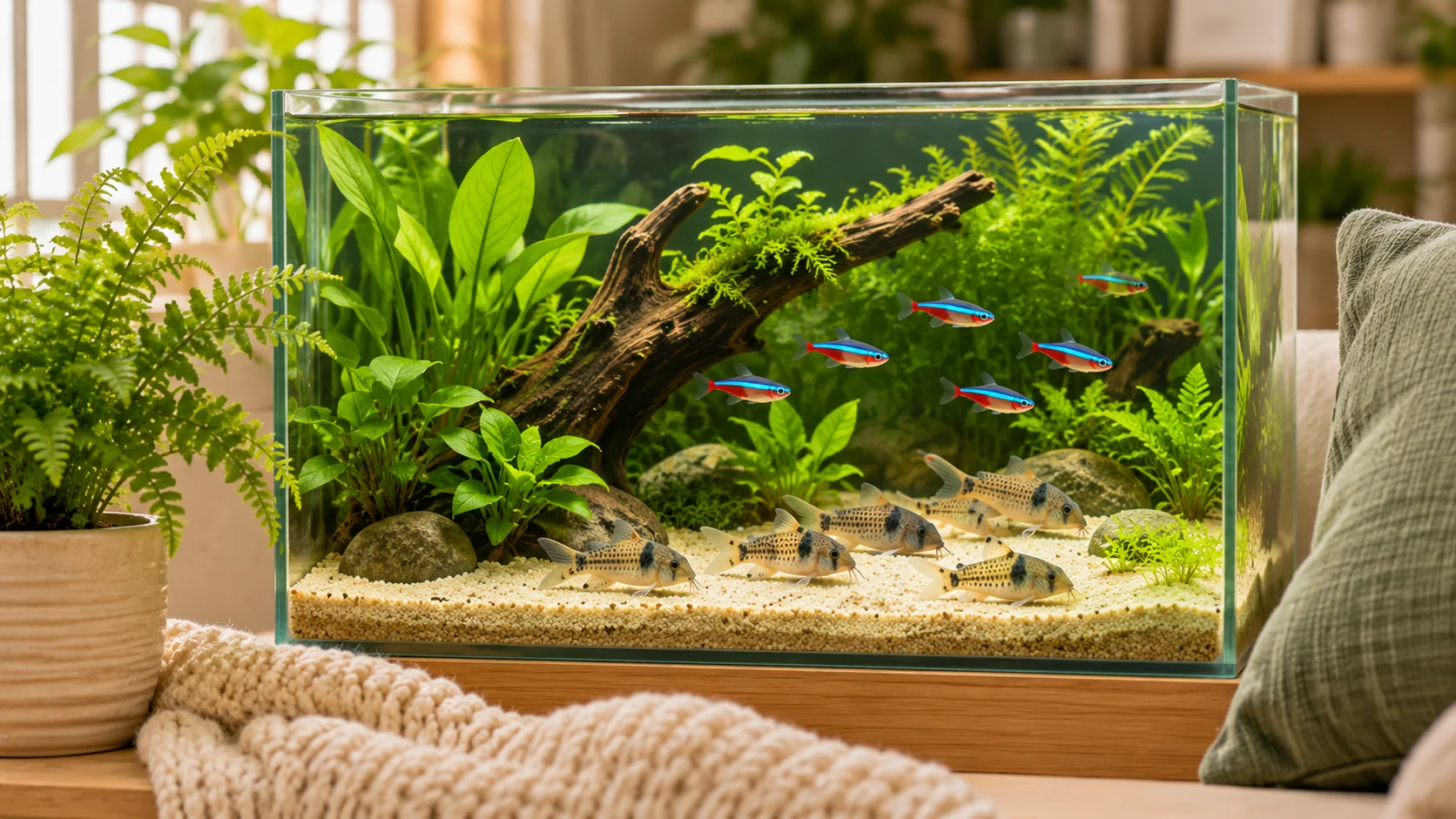
Fish are one of the calmest pets a family can keep. They're quiet, they suit small homes and families with allergies, and a well-kept tank gives kids something living to watch, feed and care for every day. They're also the pet most often sold with the wrong setup: a bowl, no heater and a promise that fish are "easy."
This guide covers what actually makes a first aquarium work, in the order you'll need it. The short version is that you're really caring for the water, and the fish come second. Get the tank running before anyone picks out a fish, and most beginner problems never happen.
The short list: a filtered tank of at least 5 gallons (20 gallons for a small group of fish), an adjustable heater, a thermometer, water conditioner, a test kit, a gravel vacuum and a bucket used only for the tank. Set it up and let it cycle for four to six weeks before fish move in. Grown-ups handle the tank water; everyone washes their hands.
Why a fishbowl isn't a good home
The classic round bowl is the most common beginner mistake, and the one to skip. The University of Illinois College of Veterinary Medicine says plainly that betta fish "should not live in bowls," because bowls are too small for normal swimming and hiding. Chewy's betta guide calls the bowl idea one of the most "persistent—and harmful" misconceptions about fish.
The problem is the water. Fish waste breaks down into ammonia, which is toxic to fish. In a small, unfiltered bowl, ammonia builds up fast and the temperature swings with the room. A filtered, heated tank keeps the water stable, which is what fish need most.
Choosing the right tank size
Bigger tanks are actually easier for beginners. More water dilutes waste and holds its temperature better, so small mistakes like overfeeding do less harm.
- One betta: 5 gallons or more. The University of Illinois recommends at least 5 gallons, and PetMD and Chewy both describe 5 to 10 gallons as a good range, with 10 gallons ideal. Some care sheets list 2.5 gallons as a bare minimum, but we'd treat 5 as the starting point for a family tank.
- A small group of community fish: about 20 gallons. Schooling fish need to live in groups, and they need room to swim together.
- Don't overstock. The CDC suggests a guideline of about 1 inch of fish per gallon of water. Add fish a few at a time, not all at once.
Every tank needs a lid, too. PetMD notes that bettas can jump.
Where to put it: on a sturdy stand that's rated for the weight (water is heavy, about 8 pounds a gallon), away from direct sun, heaters and drafts, and somewhere kids can watch at eye level without reaching in. Choose the spot before you fill the tank, because a full tank can't be moved.
A sleek 5-gallon kit with a built-in filter and light that fits on a dresser or desk. Add a small adjustable heater.
Check price on AmazonAnother 5-gallon kit with the filter hidden at the back. Bettas need warm water, so budget for a heater.
Check price on AmazonA 20-gallon kit gives a small school of peaceful fish room to swim together, and the extra water is more forgiving for beginners. Check that the listing includes a filter and heater, or buy them separately.
Check price on AmazonCycle the tank before fish come home
This is the step that pet store impulse buys skip, and it's the reason so many first fish die in the first few weeks. Vets and fish keepers call it "new tank syndrome."
Here's what happens. Fish waste and leftover food make ammonia. Over time, helpful bacteria grow in the filter and gravel and turn that ammonia into nitrite, and then into nitrate. PetMD explains that ammonia and nitrite are "highly toxic to fish," while nitrate is relatively safe in normal amounts. A brand-new tank doesn't have those bacteria yet. Building them up is called cycling the tank.
- How long it takes: PetMD says four to six weeks, and warmer tanks cycle faster than cooler ones.
- How to tell it's ready: test the water. During cycling you'll see ammonia rise, then nitrite, then nitrate. The tank is ready when ammonia and nitrite read zero and nitrate is showing.
- Add fish slowly. PetMD recommends starting with a small share of the fish you plan to keep, so the bacteria can catch up. If a friend has a healthy, established tank, a little of their used filter media can give yours a head start.
- Be wary of "instant cycle" claims. PetMD says products that claim to instantly establish the nitrogen cycle are generally ineffective. Testing is the only way to know.
If ammonia or nitrite show up after fish are in the tank, the fix is a partial water change. PetMD advises changing no more than half the water at once.
Cycling is a good lesson for kids, too. Waiting a few weeks for the tank to be ready, and testing the water together, teaches that a pet's home comes first. Make a countdown calendar and let them check off each day.
The best beginner fish for families
Pick the fish to suit the tank you've set up, not the other way around. Ask the store about adult size, temperature and how many of a kind should live together before you buy.
Betta fish: the classic first fish
A single betta in a heated, filtered 5- to 10-gallon tank is one of the best first pets for a child. Bettas are colorful, curious and easy to watch, and many learn to come to the front of the tank at feeding time.
- Keep one male per tank. The CDC notes that male bettas can't live in the same aquarium together. Female bettas are sometimes kept in groups, but PetMD says only in tanks of at least 10 gallons, and that's not a beginner project.
- Warm water: PetMD and the University of Illinois both give 76 to 81°F. PetMD says a steady temperature matters more than hitting an exact number, so use a heater and a thermometer even if your house feels warm.
- Gentle filter: bettas have long fins and aren't strong swimmers. The University of Illinois says a low-flow filter is best, because strong suction can hurt their fins. PetMD suggests an air-driven sponge filter.
- Lifespan: PetMD gives 3 to 5 years with good care, which is a good length of commitment for a young child.
A small community tank
If your family wants a busier tank, a 20-gallon community tank of small, peaceful fish is the next step. Corydoras catfish, small tetras and rasboras are popular choices; PetMD lists all three as fish that can share a larger tank with a betta. Most of these are schooling fish that need to live in groups, so plan the whole group before you buy, and add them a few at a time as the tank allows.
Avoid fin-nipping species such as tiger barbs in any tank with long-finned fish. PetMD specifically warns against them with bettas.
What about goldfish?
Goldfish are the fish most kids picture, and the one most often kept in a bowl. They grow much larger than people expect and produce a lot of waste, so they need a big, well-filtered tank and aren't the easy starter fish their reputation suggests. If your child has their heart set on goldfish, research the adult size of the type you're buying and plan the tank around it.
And whatever you keep, never release pet fish into a pond, stream or lake. The CDC advises against releasing aquarium fish outdoors.
Gear checklist
Most of this is a one-time cost. For a full first-year budget, try our pet cost calculator, which puts a betta setup at roughly $565 for the first year.
- Heater: an adjustable heater sized for your tank. PetMD suggests about 3 to 5 watts per gallon.
- Thermometer: so you can check the heater is doing its job. A stick-on or digital thermometer is easy for kids to read.
- Filter: most kits include one. For a betta, a gentle sponge filter is a good swap.
- Water conditioner: tap water contains chlorine or chloramine, which harm fish. Treat every bucket of new water. The University of Illinois says not to use distilled water.
- Test kit: for cycling and for checking the water every week.
- Gravel vacuum: cleans the gravel while it drains water for a water change.
- A bucket used only for the tank: never one that's held soap or cleaners.
- Plants and hiding places: live plants such as anubias and java fern are hardy and help keep the water clean. The University of Illinois cautions against decor with sharp edges that can tear fins, and against filling too much of the tank.
- Food: betta pellets for a betta, or flakes or micro pellets for community fish.
- Gloves: long aquarium gloves for whoever cleans the tank.
Feeding: less is more
Overfeeding is the most common way kids accidentally harm fish, because leftover food rots and pollutes the water. The University of Illinois recommends feeding a betta an amount it can eat in 3 to 5 minutes, and PetMD says once or twice a day. Scoop out anything left over.
A simple fix for families: one child is the "feeder" for the week, and a grown-up measures the food into a small dish so there's no shaking the whole container into the tank.
Weekly care routine
- Every day: feed, check the thermometer and count the fish. Look for anything unusual, like a fish hiding all day, clamped fins or not eating.
- Every week: test the water and change part of it. PetMD recommends changing 15 to 25% of a betta tank's water weekly. Vacuum the gravel as you drain, and treat the new water with conditioner and match its temperature before adding it.
- As needed: rinse the filter sponge in old tank water you've just removed, not tap water, so you don't kill the helpful bacteria. Follow the filter maker's instructions for cartridges.
- Right away: remove a fish that has died. The CDC advises taking out dead fish promptly.
Kids and fish: the CDC's safety rules
Fish can't be cuddled, which makes them a good "look, don't touch" pet. But tank water can carry germs that make people sick, even if nobody touches a fish. The CDC lists Salmonella and a skin infection called fish tank granuloma among the illnesses people can get from aquariums. Here's how to keep everyone healthy:
- Wash hands with soap and running water after feeding the fish, touching the tank water or handling anything from the tank. Adults should supervise handwashing for young children.
- Grown-ups clean the tank. The CDC says not to let children younger than 5 clean or handle aquarium items. We recommend leaving water changes and filter cleaning to an adult for children of any age, at least at first. Older kids can help by testing water, reading the thermometer and feeding.
- Not in the kitchen sink. The CDC suggests dumping tank water in a bathtub, laundry sink or outside instead, then cleaning and disinfecting the sink or tub.
- Wear gloves, especially with a cut or scrape on your hands. Wash any scratch from the tank with soap and water right away, and see a doctor if it becomes red, warm, swollen or painful. Mention that you keep fish.
- Extra care for higher-risk family members. The CDC says children under 5, adults 65 and older and people with weakened immune systems are more likely to get seriously ill from germs fish can carry. Where possible, someone else in the household should look after the tank.
For more on choosing a pet that suits your child's age, see our guide to the best first pets for kids, or answer a few questions in our Pet Finder.
Sources
- CDC, Fish (Healthy Pets, Healthy People)
- PetMD, Betta Fish Care Sheet
- PetMD, New Tank Syndrome in Fish
- University of Illinois College of Veterinary Medicine, Bettas Need More Than Bowls
- Chewy, What Size Betta Fish Tank Do I Need?
A family of pet keepers in Olney, Maryland, writing practical guides for parents. We research and compare products ourselves; we're not vets, so health questions go to one.
More about us