

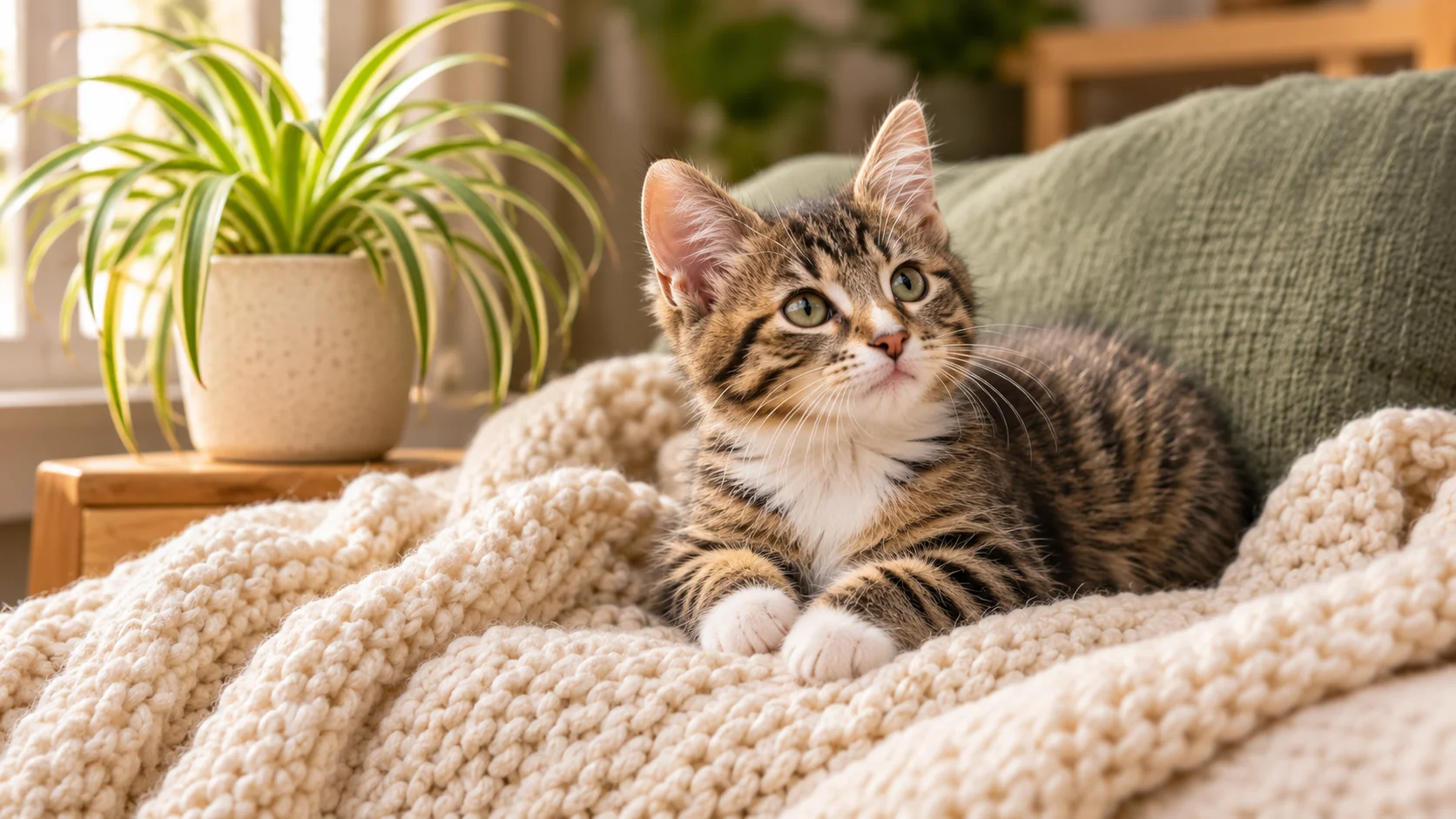
A cat tree looks like a nice extra, but in a house with children it does an important job. It gives your cat somewhere high to go when the house gets loud, a place to scratch that isn't the sofa, and a spot to watch the world from the window. Because a good one costs real money and takes up real floor space, it's worth choosing carefully.
This guide is part of our first cat checklist. For the full first-year budget, try the pet cost calculator.
The short version: choose the sturdiest tree you can fit, with a wide, heavy base, a solid wood or thick engineered-wood frame and sisal-wrapped posts. At least one perch should be high and roomy enough for your cat to lie down fully. Put it near a window, anchor tall trees to the wall, and treat the top perch as the cat's "leave me alone" spot.
Why a cat tree matters with kids
Cats feel safest when they can get up high and watch. Children move fast, make noise and often want to pick a cat up. A tall tree gives the cat an escape route it controls, and it gives kids a simple, visible rule: when the cat is up on its tree, leave it alone. Our guide to kids and cat safety explains more of these family rules.
1. Stability comes first
A tree that wobbles when the cat jumps on it is a tree the cat stops using, and a tall one that tips can hurt a child. Look for:
- A wide, heavy base. The taller the tree, the wider the base needs to be.
- Thick posts. Slim posts flex. Thicker posts feel solid under a jumping cat.
- A solid frame. Chewy's buying guide notes that solid wood is the most durable frame, with engineered wood as the usual alternative.
- A wall anchor. Many tall trees come with an anti-tip strap. Use it, especially if children might climb or pull on the tree.
Read customer reviews for words like "wobbly" or "leans." Stability problems show up quickly in real homes, and big or heavy cats find them first.
2. Height and perch size
Chewy groups trees into small and medium trees (under about 60 inches, with one or two perches) and large trees (60 inches or more, with four or more perches). For a family home, a taller tree is usually worth it, because height is what makes the top perch feel safe.
Check the size of the top perch, not just the height. Many trees have small, shallow platforms that look fine in photos but are too tight for an adult cat to curl up on. A large cat needs a perch big enough to lie down on fully. If the listing gives perch dimensions, compare them to your cat stretched out on the floor.
A tall tree with several perches, hideaways and sisal posts. Pick a model with a wide base and use the wall strap.
Check price on AmazonA heavier tree with thick posts and roomy platforms, built for large cats or more than one cat.
Check price on Amazon3. Scratching surfaces
Scratching is normal cat behavior, and a tree is one of the best places for it. Chewy notes that sisal is the most common and durable scratching material. Look for posts wrapped in sisal rope from top to bottom, and check that the posts are tall enough for your cat to stretch out fully while scratching.
Cats have preferences. Some like to scratch upright posts, and others prefer flat or angled surfaces. Watch where your cat scratches now. If it goes for the rug rather than the sofa arm, add a horizontal or angled scratcher next to the tree.
4. Hideaways, hammocks and extras
- Condos (enclosed boxes) are good for shy cats. In a home with more than one cat, Chewy recommends condos with both an entrance and an exit, so one cat can't trap another inside.
- Hammocks and baskets are popular but wear out faster than solid platforms. Check whether replacement parts are sold.
- Dangling toys are fun, but they're usually the first thing to break. Remove loose strings or broken pieces right away.
- Replaceable posts make a tree last much longer, since sisal posts wear out first.
5. Modern and space-saving options
If the carpet-covered look doesn't fit your home, there are good-looking alternatives, usually at a higher price:
- Modern wood cat trees use real wood and fabric pads instead of carpet.
- Wall-mounted shelves create a climbing route without taking up floor space. They must be screwed securely into studs, and they work best combined with a scratching post on the floor.
- Window perches give a cat a sunny lookout. Choose one rated for your cat's weight and check the mounts regularly.
6. More than one cat
Cats that share a home often don't want to share the same perch. Give each cat its own high spot, either with one large tree that has several top-level perches, or with two smaller trees in different places. Spreading resources out cuts down on squabbles.
7. Where to put it
- Near a window if you can, so the cat has something to watch.
- In a room the family uses, not hidden away. Cats like to be near people, just out of reach.
- Away from the busiest walkway, such as right next to a door kids run through.
- Measure first. Check the room's ceiling height and, as Chewy points out, that the boxed or assembled tree will fit through your door.
Kids and the cat tree: family rules
- The tree is the cat's, not a jungle gym. Kids don't climb it, hang on it or lift the cat down from it.
- Up high means "not now." If the cat is on its tree, wait for it to come down.
- Play from a distance. A wand toy lets kids play with the cat near the tree without using hands.
- Grown-ups check it. Once a month, tighten bolts, check the wall strap and look for loose strings or worn sisal.
What to skip
- Very cheap, tall trees with thin posts. They wobble and often go unused.
- Tiny top perches an adult cat can't lie on.
- Tall trees without an anchor in a home with young children.
Sources
A family of pet keepers in Olney, Maryland, writing practical guides for parents. We research and compare products ourselves; we're not vets, so health questions go to one.
More about us